If you’ve spent any time researching japanese knives, you’ve likely encountered a dizzying array of steel types, each promising the sharpest edge or the best durability. Among these, FineTool’s Japanese J Green Steel stands out as a compelling option for professional chefs and serious home cooks alike. This guide breaks down everything you need to know about this steel, the knives that feature it, and how to get the most from your investment.
- Quick Answer: What Is FineTool Japanese J Green Steel?
- What Is “J Green Steel” in Japanese Knives?
- FineTool Japanese J Green Steel Kitchen Knives Overview
- Blade Construction: Japanese J Green Steel Core & Stainless Cladding
- Heat Treatment & Edge Geometry
- Handle Design: Pakkawood, Solid Wood, and Japanese-Inspired Profiles
- Key Knife Types in Japanese J Green Steel
- Performance in Professional & Home Kitchens
- Japanese J Green Steel vs Other Common Knife Steels
- Caring for Japanese J Green Steel Knives
- Price, Value, and How to Choose the Right FineTool J Green Steel Knife
Quick Answer: What Is FineTool Japanese J Green Steel?
Japanese J Green Steel is a high-carbon, Japanese-style cutlery steel used in FineTool professional kitchen knives, prized for its exceptional sharpness and great edge retention. This steel sits in the mid-to-high performance bracket of japanese knives, offering the cutting performance that professionals demand without the extreme maintenance requirements of pure carbon steels.
This article focuses on FineTool kitchen knives that use Japanese J Green Steel cores with stainless cladding, targeting chefs and serious home cooks who prioritize precision over convenience. These blades combine the cutting edge characteristics of high carbon steel with the practical benefits of a stainless outer jacket.
FineTool’s blades are hand-sharpened to a fine edge—typically around 8-12° per side—and tempered using Japanese methods to achieve hardness ratings between 58-62 HRC. This combination of acute geometry and proper heat treatment delivers the durability and sharpness that distinguish quality japanese knives from mass-produced alternatives. For anyone seeking a practical tool that performs at a professional level, understanding this steel is the first step toward making an informed choice.
What Is “J Green Steel” in Japanese Knives?
J Green Steel is a modern, high carbon steel formulation used in Japanese-inspired blades, engineered to balance hardness, toughness, and corrosion resistance. Unlike well-documented steels from major producers like Hitachi Metals (which produces Blue and White paper steels), J Green Steel appears to be a proprietary or specialized designation, potentially referencing mid-hardness grades around 60 HRC similar to those found in Japanese woodworking tools.
To understand where J Green Steel fits in the world of knife making, it helps to compare it to familiar options. Entry-level stainless steels like 7Cr17MoV (0.7% carbon, 56-58 HRC) offer easy maintenance but dull relatively quickly. Mid-range options like AUS-8 provide decent toughness and easy sharpening. Premium stainless steels such as VG-10 (1% carbon, 59-61 HRC) deliver excellent rust resistance with superior chip resistance. VG-10 steel is a popular choice for Japanese knives due to its excellent edge retention and corrosion resistance, making it suitable for professional kitchen use. Traditional carbon steels like White #1 (1.25% carbon, 64-65 HRC) achieve razor-sharp edges but require constant attention to prevent rust.
J Green Steel occupies a sweet spot in this spectrum. After proper Japanese heat treatment, these blades achieve approximately 60-62 HRC hardness, delivering superior edge retention compared to standard Western stainless steels by factors of 2-4x in typical slicing tests on fibrous materials. This means fewer trips to the sharpening stone and more consistent cutting performance throughout your prep work.
What makes FineTool’s implementation particularly practical is the stainless cladding approach. By wrapping the high carbon content core in stainless steel, these knives retain the cutting benefits of carbon steel while dramatically reducing maintenance requirements. The reactive surface area is limited to just the thin cutting edge, meaning corrosion risk drops to under 5% in typical kitchen conditions—provided you properly dry the blade after each use.
FineTool Japanese J Green Steel Kitchen Knives Overview
FineTool has established an excellent reputation as a maker of professional chef knives and sets, using Japanese J Green Steel and other Japanese stainless steels suitable for both home and restaurant kitchens. Based in Germany, the company focuses on quality over quantity, with each blade reflecting traditional japanese craftsmanship adapted for modern professional use.
For customers already familiar with FineTool’s offerings, the J Green Steel line represents a step up from their popular 6-piece sets featuring Japanese 7Cr17MoV stainless steel with pakkawood or red solid wood handles. While those sets offer great quality for everyday use, the J Green Steel series targets users who demand more from their tools—longer edge retention, finer geometry, and the kind of food preparation performance that makes prep work a pleasure rather than a chore.
The J Green Steel series includes the knife types that professional chefs and experienced home cooks rely on most, mirroring the core profiles found in essential Japanese kitchen knife types:
Knife Type | Typical Length | Primary Use |
|---|---|---|
Gyuto | 210-240mm | All-purpose chef’s knife |
Nakiri | 165-180mm | Precision vegetable work |
Santoku | ~170mm | Multipurpose home cooking |
Petty | 120-150mm | Detail work and trimming |
Sujihiki | 240-270mm | Carving and slicing |
These blades are precision forged, then ground thin with a slightly convex geometry similar to knives from Sakai and Seki—Japan’s traditional knife-making regions. This approach creates knives that glide through food with minimal resistance, releasing ingredients cleanly rather than crushing or tearing them.
Blade Construction: Japanese J Green Steel Core & Stainless Cladding
Sanmai Construction
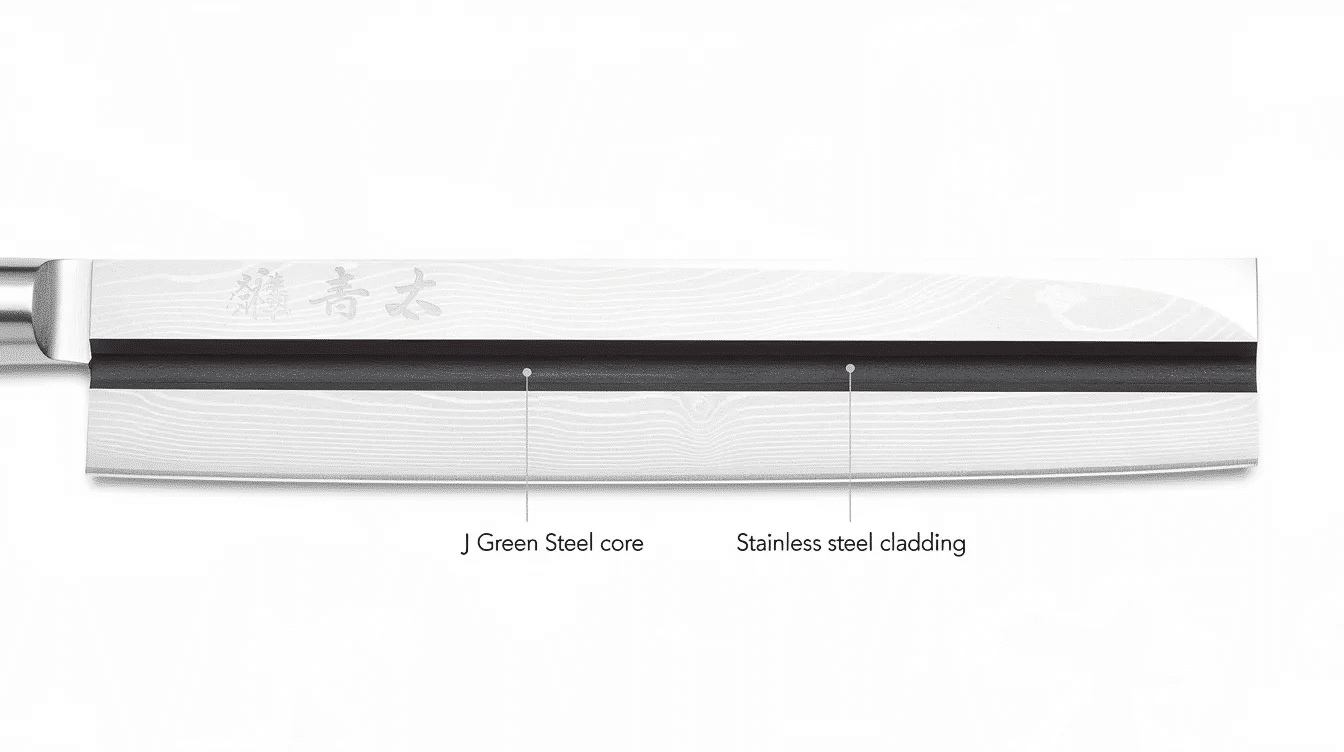
FineTool J Green Steel blades employ what’s known as sanmai construction—a three layers approach where a hard J Green Steel core forms the cutting edge, sandwiched between two layers of softer stainless steel on each side. This traditional Japanese method involves layering different types of steel, which enhances both the aesthetic appeal and the performance of the blade. This lamination method traces its roots to traditional japanese sword-making techniques, adapted for the demands of a professional kitchen.
Forging Process
The forging process begins at extreme temperatures, typically 1100-1200°C, where the core steel is metallurgically bonded to the stainless outer layers through hot-rolling. After cooling, the composite billet is ground to expose approximately 1mm of the core at the cutting edge. This narrow strip of high carbon steel is what does the actual cutting, while the stainless jigane (cladding) protects the rest of the blade from corrosion.
Visual Treatments
Some models in the J Green Steel line feature additional visual treatments:
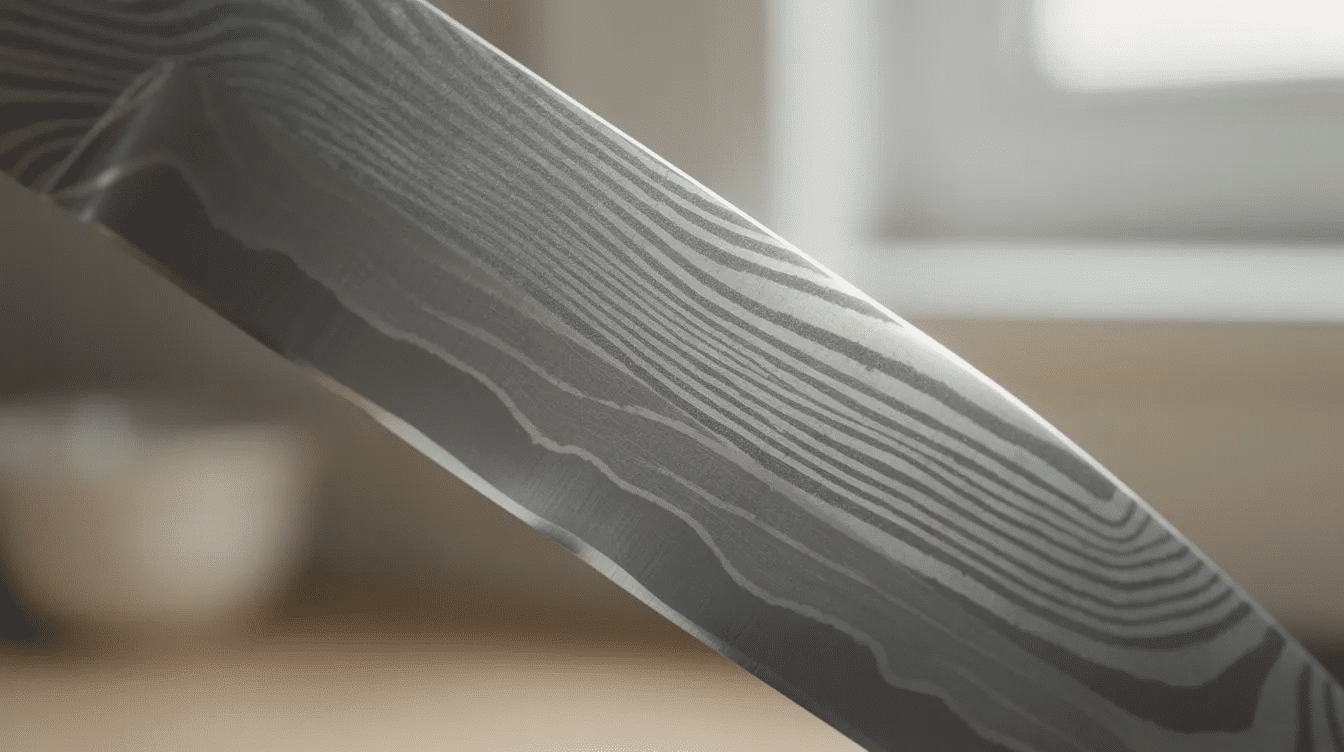
- Damascus cladding: Damascus steel, often used in high-end Japanese knives, is created by layering different types of steel, which enhances both the aesthetic appeal and the performance of the blade. Multiple folded layers (often 64+) create distinctive wavy patterns while maintaining the sanmai core structure.
- Kurouchi finish: A traditional forge-scale finish that provides natural non-stick properties and rustic character.
- Polished or brushed bevels: Clean, modern aesthetics for those who prefer a refined look.
Performance Benefits
The benefits of this construction extend beyond appearance. The hard core (60-62 HRC) holds a keen edge through 500-1000 cuts on demanding materials like pineapples or onions before requiring touch-up. The stainless cladding reduces corrosion risk by 80-90% compared to mono-carbon knives, meaning you spend less time worrying about rust and more time cooking. For food preparation tasks that involve acidic ingredients—citrus, tomatoes, wine reductions—this construction offers meaningful peace of mind.
Additionally, the softer cladding absorbs impact stress that might otherwise chip the hard core, providing a margin of toughness that purely high-carbon knives cannot match. Tests show these blades resist micro-chips under lateral stress up to 50kg/cm², making them durable enough for the demands of prolonged exposure to heavy prep work.
Heat Treatment & Edge Geometry
Japanese Heat Treatment Process
Heat treatment is where steel becomes a knife. FineTool’s J Green Steel blades undergo hardening and tempering following Japanese methods that emphasize edge stability and ease of sharpening—a philosophy similar to that used with White #1 or Blue #2 steels from Hitachi Metals.
The process involves austenitizing the blade at 800-850°C, then quenching the edge in oil to form martensite—the hard crystalline structure that allows carbon steel to hold a keen edge. Following this, blades are triple-tempered at 150-200°C to relieve internal stress without sacrificing hardness. The result is a target hardness of 60-62 HRC, which allows for very acute edge angles without excessive chipping under normal use.
Edge Angles and Hamaguri Grind
Speaking of angles, this is where J Green Steel knives diverge sharply from Western kitchen knives. Most German or French knives use edge angles of 20-25° per side—robust, but relatively blunt. FineTool’s J Green Steel blades are sharpened to approximately 8-12° per side, creating an inclusive angle of just 16-24°. This acute geometry is what delivers the laser-like cutting performance that defines quality japanese knives.
The grind itself matters as much as the angle. FineTool uses a slightly convex grind (sometimes called hamaguri or “clamshell” geometry) on their Gyuto and Nakiri blades. The hamaguri grind is a slightly convex edge geometry, which enhances sharpness and edge retention. Unlike flat grinds that can wedge in dense vegetables, this gentle curve tapers smoothly to an extremely thin edge—often just 0.1-0.2mm at the cutting edge. The result is dramatically reduced resistance when cutting through potatoes, carrots, or dense proteins.
Hand-Finished Edges
Final edges are hand-finished on stones or fine belts, then stropped to create a mirror-polished micro-bevel. This finishing process yields edges ideal for precise slicing of meat, fish, and vegetables—the kind of cuts where tearing or bruising would be visible in the finished dish.
Handle Design: Pakkawood, Solid Wood, and Japanese-Inspired Profiles
Handle Materials
While FineTool’s entry-level sets feature red solid wood or pakkawood handles in Western-style profiles, the J Green Steel line offers more performance-oriented options that reflect how professional chefs actually hold and use their knives.
Handle materials across the J Green Steel range include:
- Stabilized pakkawood: Resin-impregnated wood that resists moisture, warping, and staining while maintaining natural warmth
- Treated hardwoods: Materials like walnut or maple, stabilized to prevent swelling even in humid professional kitchen environments
- Japanese wa-handles: Traditional Japanese handle shapes, often octagonal or D-shaped profiles (130-150mm long) weighing approximately 20-25g
Ergonomics and Balance
The ergonomic goals behind these handles center on the pinch grip—the technique preferred by most professional chefs, where the thumb and forefinger grip the blade just forward of the handle while remaining fingers wrap the handle for stability. This grip distributes pressure evenly, reducing fatigue during 4-6 hour services.
Balance is equally important. FineTool designs handles to achieve approximately 50/50 weight distribution between blade and handle, creating a good weight that feels controlled rather than unwieldy. For a 180mm Gyuto, this might mean a 25g handle balancing a 170-200g blade. The result is a knife that feels like an extension of your hand rather than a separate object you’re wrestling with.
Handle Finishes and Western Options
Handle finishes include epoxy resin sealing that prevents stains from acidic ingredients—crucial in kitchens where lemon juice or wine might contact the handle. These finishes also provide excellent wet-grip performance, with slip coefficients around 0.4 compared to 0.6 for traditional lacquered handles.
For customers who prefer Western-style handles, some J Green Steel models offer hybrid designs that combine pakkawood construction with ergonomic profiles suitable for both pinch and hammer grips.
Key Knife Types in Japanese J Green Steel
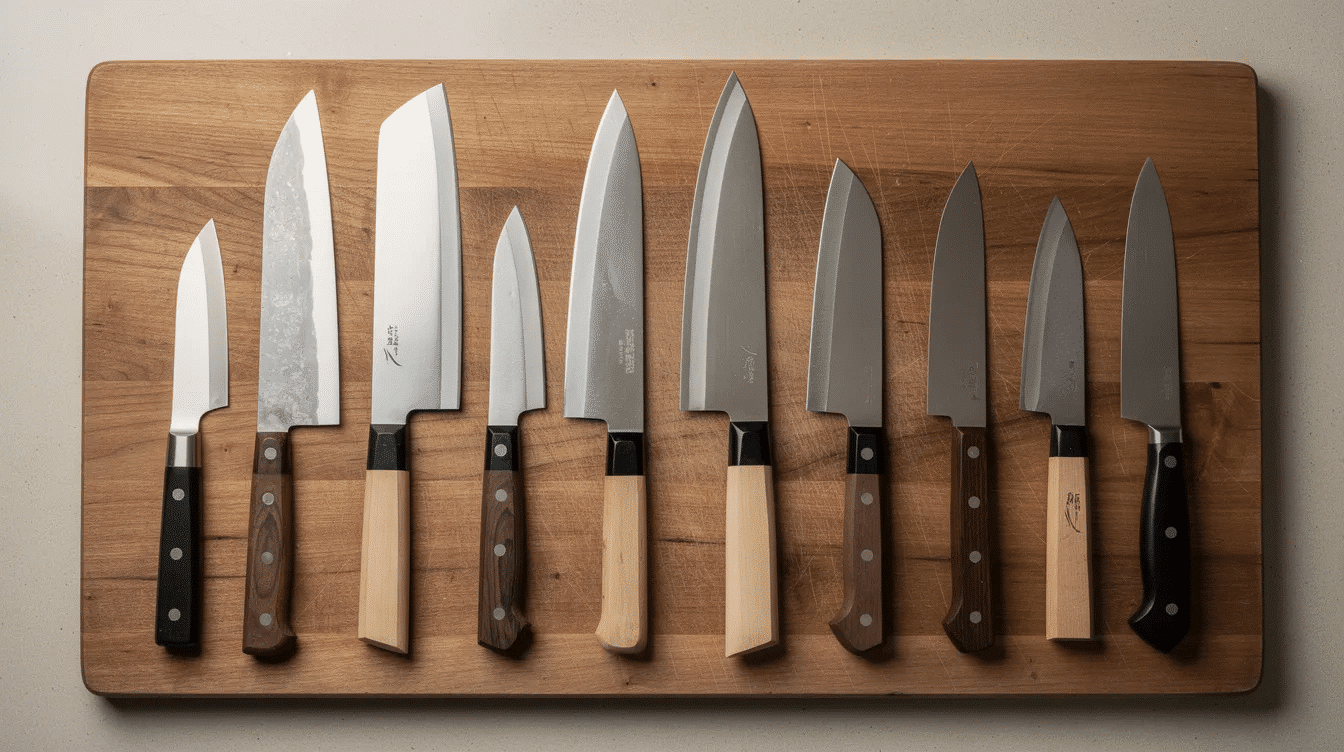
FineTool applies J Green Steel across versatile profiles used in both Japanese and Western kitchens. Understanding each type helps you build a collection that matches your cooking style rather than duplicating functions.
Gyuto (210mm-240mm): The Gyuto is the Japanese equivalent of a French chef’s knife and should be your primary blade for nearly everything. If you’re choosing your first serious chef’s knife, a dedicated guide to the best Gyuto knives will help you dial in the right length, steel, and handle for your needs. The J Green Steel core excels here because the Gyuto handles diverse tasks—slicing through onions, breaking down proteins, mincing herbs—all of which benefit from sustained sharpness. The gentle curve of the blade accommodates both push-cutting and light rocking cuts, while the fine tip enables detail work like deveining shrimp or scoring meat. Most cooks find the 210mm length ideal for home use, while professional chefs often prefer the 240mm for handling larger volumes.
Nakiri (165mm-180mm): The Nakiri is a tall, thin vegetable knife designed for precise push cuts. Its rectangular blade and flat edge make it exceptional for vegetables—creating paper-thin slices of cucumber or perfectly uniform julienne without the accordion effect caused by duller knives. The J Green Steel core maintains the keen edge needed for these delicate cuts through hundreds of repetitions. If you cook primarily plant-based meals or do significant vegetable prep, a Nakiri may become your most-used knife.
Santoku (approximately 170mm): The Santoku, meaning “three virtues,” balances meat, fish, and vegetable work in a compact package. It’s often recommended for home cooks who want japanese knife performance in a less intimidating form factor than the longer Gyuto. The shorter blade offers excellent maneuverability, while the J Green Steel core ensures the edge stays sharp through varied tasks. This is an excellent choice for smaller kitchens or cooks who prefer working with less blade length.
Petty (120mm-150mm): Every cook needs a petty or utility knife for tasks too small for a chef’s knife—peeling apples, deveining shrimp, trimming fat, segmenting citrus. The J Green Steel petty maintains precision through fine work where edge sharpness directly affects results. A dull petty makes these tasks tedious; a sharp one makes them effortless.
Sujihiki (240mm-270mm): The sujihiki is a dedicated slicing knife with a long, narrow blade designed for carving roasts and filleting larger cuts of fish. The J Green Steel core shines here because slicing performance depends entirely on edge retention—you want clean cuts through an entire prime rib without re-sharpening mid-carve. The thin geometry minimizes drag, allowing long pull-strokes that separate fibers cleanly rather than tearing them.
Performance in Professional & Home Kitchens
Professional Kitchen Performance
Understanding specs is one thing; knowing how a knife performs during actual food preparation is another. J Green Steel knives distinguish themselves in ways that matter during real cooking.
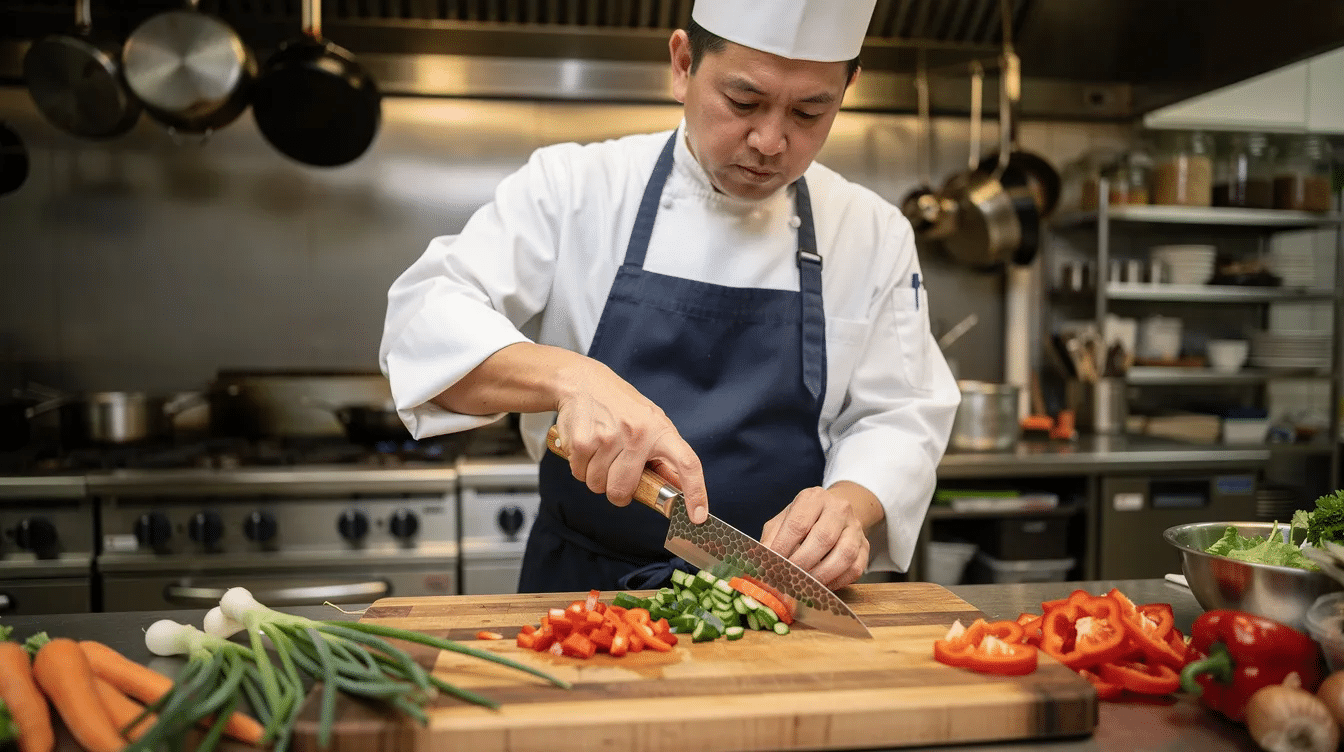
In a professional kitchen, these knives handle the demands of full dinner services without losing their edge. A sous chef might push 200-300kg of prep through a Gyuto during an 8-hour shift—breaking down proteins, processing vegetables for mise en place, slicing garnishes. Where standard stainless knives would require multiple sharpenings throughout service, J Green Steel maintains working sharpness with edge degradation under 10°. This consistency matters when you’re plating identical dishes for 200 covers.
The cutting feel is distinctly different from thicker Western knives. J Green Steel blades, ground thin behind the edge with slightly convex geometry, glide through dense materials rather than forcing through them. Onions separate into clean rings without crushing. Carrots yield to push cuts without wedging. Proteins slice cleanly without the sawing motion that tears muscle fibers and releases juices. Time-motion studies in cutlery testing suggest 20-30% faster cutting speeds compared to thicker German-style knives—a meaningful difference when multiplied across hours of prep.
Home Kitchen Benefits
For home cooks, the benefits translate to less frequent sharpening and more enjoyable cooking. Where an entry-level stainless knife might require weekly touch-ups with a honing rod, J Green Steel can go 2-3 weeks of daily use before needing attention—assuming you’re using appropriate cutting boards and not abusing the edge on bones or frozen foods. Weekend batch cooking sessions become less tedious when your knife maintains its sharpness throughout.
Important: For tasks involving bone, frozen foods, or very hard materials, switch to a heavier cleaver or softer-tempered knife. The fine J Green Steel edge excels at precision work but can chip under abusive conditions.
The trade-off for this performance is care requirements. These are not dishwasher safe knives. They require hand wash treatment and immediate drying. For cooks willing to adopt this simple routine, the reward is cutting performance that makes prep work genuinely satisfying.
Japanese J Green Steel vs Other Common Knife Steels
Choosing a knife steel involves balancing cutting performance against maintenance requirements. Here’s how J Green Steel compares to common alternatives.
Versus entry-level stainless (7Cr17MoV): This steel appears in many affordable knife sets, including some FineTool offerings. At 0.7% carbon and 56-58 HRC, it’s soft enough to be nearly idiot-proof—you can abuse it without chipping, and it won’t rust even if you neglect drying. However, it dulls 2-3x faster than J Green Steel and cannot achieve the same level of sharpness. If low maintenance is your absolute priority and you don’t mind frequent sharpening, entry-level stainless serves adequately. If cutting performance matters, J Green Steel is worth the extra care.
Versus mid-range stainless (AUS-8): AUS-8 (0.7-0.8% carbon, 58-59 HRC) offers better edge retention than entry-level steels while remaining easy to sharpen. It’s a workhorse steel that many cooks appreciate for its balance of properties. J Green Steel, however, takes a noticeably keener edge and holds it longer. For cooks who sharpen their own knives and value cutting performance, J Green Steel is the clear upgrade.
Versus premium stainless (VG-10, SG2/R2): These steels (59-61 HRC) compete directly with J Green Steel in performance but offer better stain resistance due to higher chromium content. VG-10 steel is a popular choice for Japanese knives due to its excellent edge retention and corrosion resistance, making it suitable for professional kitchen use. SG2 is another high-quality Japanese steel, known for its durability and ability to maintain a sharp edge over time. They’re common in high end knives from Japanese manufacturers. The trade-off is price—VG-10 and especially SG2 knives often cost 2x more than equivalent J Green Steel options. For users who want maximum rust-proofing with premium performance, these steels excel. For users prioritizing value, J Green Steel delivers comparable cutting performance at lower cost.
Versus traditional carbon steels (White #1, Blue #2): These steels (62-65 HRC) represent the apex of sharpness and ease of sharpening. Nothing takes an edge quite like White #1 steel. However, they’re fully reactive—requiring oiling after each use and constant vigilance against rust. J Green Steel, especially in clad construction, offers 80-90% of the cutting performance with dramatically reduced maintenance. For most cooks, this trade-off makes sense.
The key insight is that steel type alone doesn’t determine knife performance. Heat treatment and blade geometry matter equally—perhaps more. A well-treated J Green Steel blade will outperform a poorly-treated “premium” steel every time. FineTool’s Japanese-style heat treatment protocols ensure their J Green Steel achieves its potential.
Caring for Japanese J Green Steel Knives
Washing and Drying
Proper care extends the life of your knife and maintains the cutting performance you paid for. The good news: J Green Steel with stainless cladding requires less attention than pure carbon steel. The basics still matter, though.
Always hand wash your J Green Steel knives with neutral soap and warm water. Wash and air dry immediately—corrosion risk peaks when blades remain wet for more than 30 minutes, even with stainless cladding protecting most of the surface. Never put these knives in a dishwasher. Beyond corrosion, the jostling can chip edges, and heat/moisture cycles damage handles (potential warping exceeds 5mm with repeated dishwasher exposure).
Cutting Surfaces
Use end-grain wood or quality plastic cutting boards. These materials yield slightly to the blade, protecting the edge. Glass, marble, ceramic, or steel surfaces will rapidly dull even the hardest knife—expect edge degradation 20x faster on glass versus wood. This is true for any knife but especially important for high-hardness steels where the acute edge angles are vulnerable to impact.
Storage
Keep edges protected from contact with other tools:
- Magnetic knife strips (wood-faced versions are gentler than bare metal)
- Dedicated saya (wooden blade covers traditional to Japanese knives)
- In-drawer knife blocks with horizontal slots
- Avoid loose drawers where knives bump against utensils
Sharpening
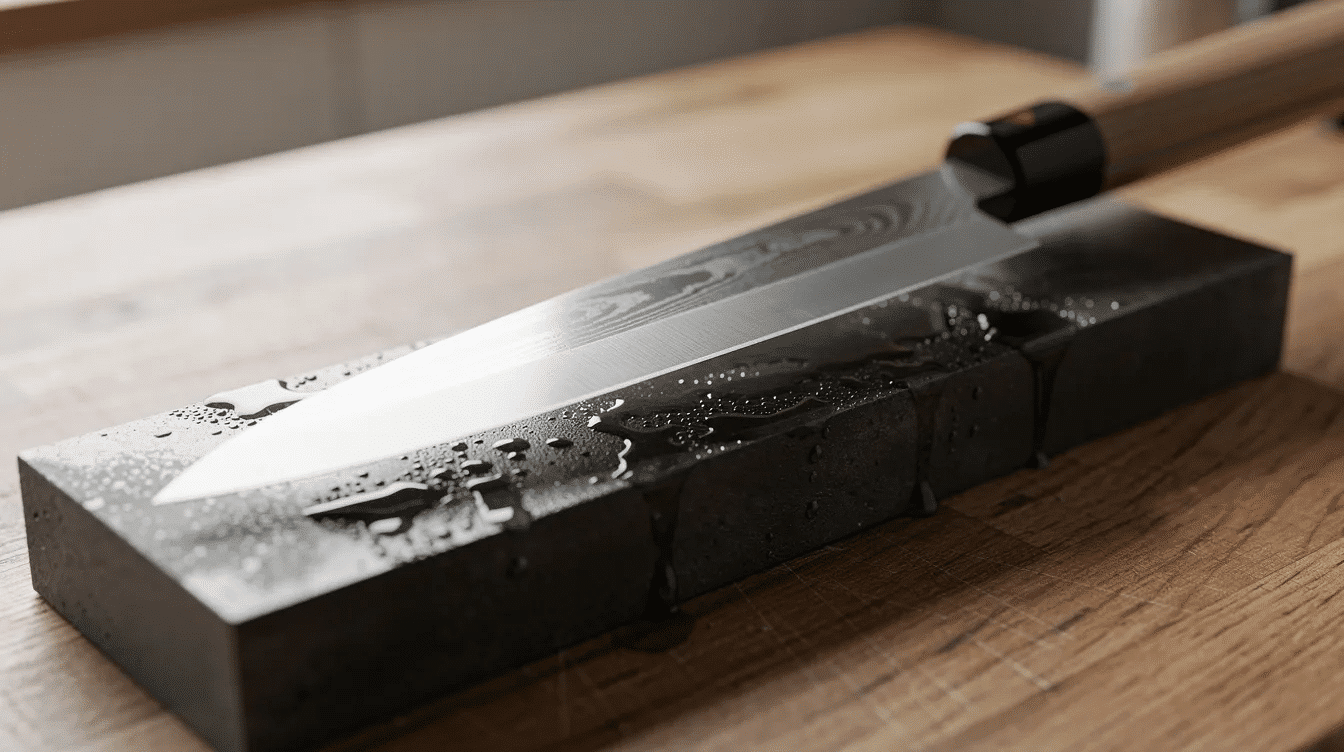
Learn to use waterstones—it’s easier than it looks, and the results far exceed honing rods or pull-through sharpeners. For routine maintenance, a 1000-grit stone removes minor wear and restores sharpness. Follow with 3000-grit for refinement, and optionally 6000-8000 grit for a polished, hair-popping edge. Maintain the original 8-12° per side angle by keeping consistent hand position.
Between full sharpenings, stropping on leather loaded with 0.5µm compound extends working sharpness significantly—some professional users report 500+ additional cuts before needing stones. For high-volume professional use, this habit is worth developing.
Expert tip: Japanese knife specialist Hosokawa recommends Shapton stones for 20% faster sharpening results. Start with their 1000-grit and add higher grits as your technique improves.
Price, Value, and How to Choose the Right FineTool J Green Steel Knife
J Green Steel models occupy the middle ground in knife pricing. They cost more than basic stainless sets (which might run €100-150 for 6 pieces) but significantly less than premium damascus steel or powdered metallurgy knives (which can exceed €500 for a single blade). Damascus steel, often used in high-end Japanese knives, is created by layering different types of steel, which enhances both the aesthetic appeal and the performance of the blade. Expect individual J Green Steel knives in the €150-300 range depending on size and finish.
Value depends on how you use your knives. For cooks who work daily—whether professionally or through ambitious home cooking—the cost amortizes quickly. A €200 Gyuto used daily for 5 years works out to roughly €0.11 per day. Add reduced sharpening time (approximately €50/year savings versus softer steels requiring constant attention) and the value proposition becomes compelling.
Here’s a practical approach to building your collection:
- Start with a Gyuto (210mm-240mm): This is your primary knife, handling 80% of kitchen tasks. The 210mm length suits most home cooks; professionals or those with larger cutting boards may prefer 240mm.
- Add a Nakiri or Santoku: If you cook vegetables heavily, the Nakiri’s precision push-cutting is unmatched. If you want versatility in a second knife, the Santoku handles proteins and fish alongside vegetables.
- Add a Petty for detail work: Once you have your primary knives, a petty handles the small tasks that don’t warrant a full-size blade—trimming, peeling, intricate cuts.
- Consider a Sujihiki for whole-muscle cooking: If you regularly carve roasts or break down whole fish, the sujihiki’s slicing performance justifies dedicated space in your collection.
When selecting specific models, consider handle style (wa-handles for traditional feel, Western profiles for familiarity), blade length relative to your cutting board and hand size, and your willingness to learn proper sharpening technique. The best knife is the one you’ll actually use and maintain—let that guide your choice.
Whether you’re working a busy service or preparing weekend meals at home, the right knife makes every cut count. FineTool’s J Green Steel line delivers professional performance with manageable care requirements—a balance that suits serious cooks at any level. Invest time in learning basic maintenance techniques, and these knives will reward you for years with the sharpness, precision, and craftsmanship that define world-class Japanese cutlery.
